

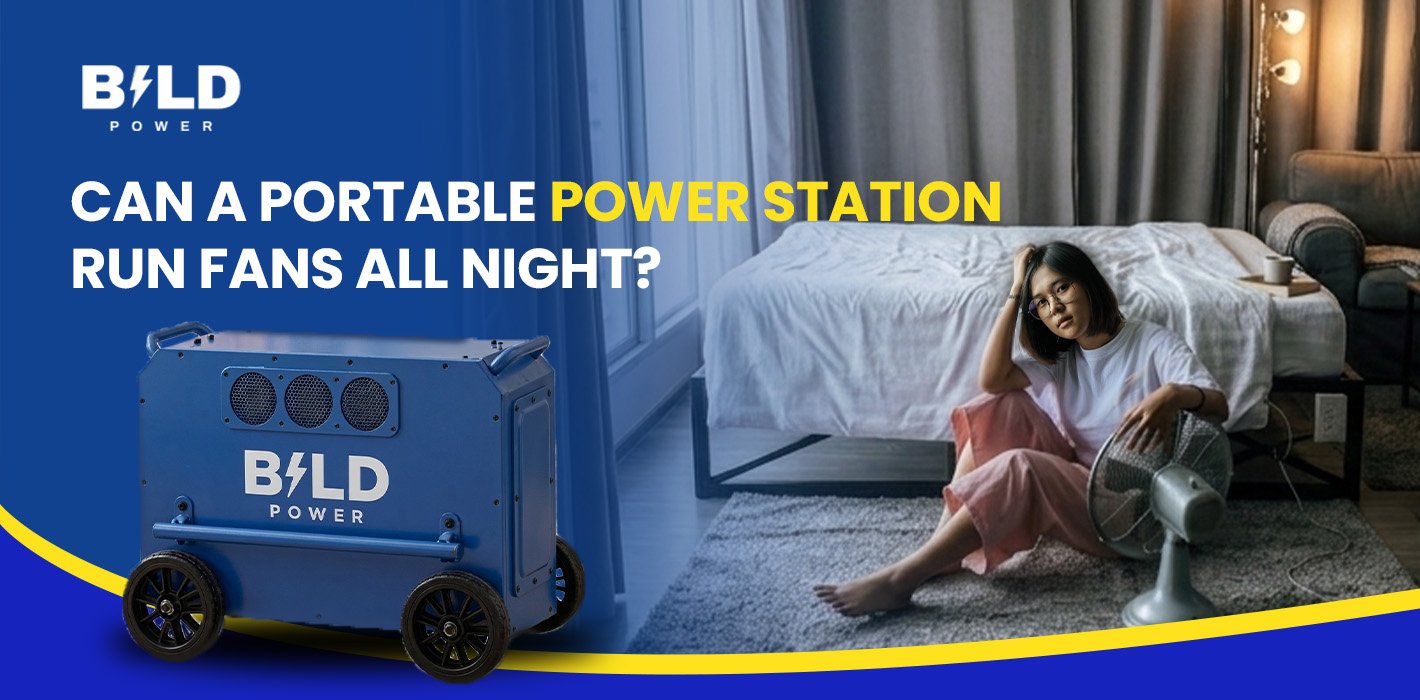
A portable power station can run fans all night because fans use very little electricity compared to most household appliances. A standard box fan draws 50 to 100 watts, while tower and ceiling fans use even less. Generally, a power station with 500Wh or more handles a single fan through an eight-hour night, and larger units run multiple fans comfortably without any issue.
Several factors determine exactly how long your power station keeps fans running, and understanding each one helps you plan better before an outage hits.
Battery capacity measured in watt-hours determines total runtime more than any other factor. A 500Wh station running a 50-watt fan lasts about ten hours, while a 1,000Wh station doubles that to twenty hours. Larger stations like the OffGrid Pro with 9,792Wh run multiple fans for days without needing a recharge, which matters enormously during extended summer outages.
Your fan’s wattage appears on a label near the power cord or on the back of the unit. Multiply that wattage by the hours you plan to run it, and the result tells you how many watt-hours you need from your power station. A 75-watt fan running for eight hours needs 600 watt-hours, so your station needs at least that much capacity to make it through the night.
Heavier fan blades made from metal or thick plastic require more power to spin than lightweight plastic blades at the same speed setting. Higher speed settings draw significantly more watts than low or medium settings, and this difference compounds over a full night of runtime. A fan running on medium speed might draw 40 watts while the same fan on high pulls 80 watts, which cuts your runtime in half.
Tower fans and modern DC-motor fans use considerably less power than older box fans or large pedestal models. A DC-motor tower fan might draw only 20 to 30 watts, while a traditional box fan pulls 75 to 100 watts for similar airflow. Choosing an energy-efficient fan model extends the battery runtime.
While a fan’s motor doesn’t naturally draw more power just because the air is hot, you are far more likely to run it on its highest speed setting during severe heat events, which accelerates battery consumption. Keeping your room as cool as possible through shade and ventilation reduces how hard your fan needs to work overnight.
Positioning your fan to pull cooler air from lower in the room or from a window facing away from direct sunlight maximizes airflow without pushing the motor harder than necessary. A fan placed in a doorway between rooms circulates air through your entire living space rather than just one corner.
Running your fan on the lowest setting that still feels comfortable saves meaningful battery capacity overnight. Most people find that medium speed provides adequate airflow for sleeping, and the power savings compared to high speed add several hours of runtime. DC-motor fans deliver strong airflow at a fraction of the wattage older fan types require.
Fans draw significantly less power compared to other mainstream appliances, so running them alongside other devices works well on any reasonably sized power station. A 50-watt fan alongside phone chargers drawing 20 watts total and a few LED lights at 30 watts uses only 100 watts combined, which a 1,000Wh station runs for ten hours without difficulty.
The calculation changes when you add larger appliances like mini-fridges or window AC units because these pull significantly more power. A small refrigerator drawing 150 watts alongside two fans and phone chargers brings your total to around 300 watts, which requires more battery capacity for overnight runtime.
Running a fan overnight on a portable power station presents no safety concerns because fans draw consistent, predictable power without surges or spikes that stress battery systems. Your power station manages this steady load easily and operates at a fraction of its capacity when running only fans, which actually extends battery life over time. Modern power stations include protection circuits that prevent overload, over-discharge, and overheating automatically.
Portable power stations run fans indoors without any carbon monoxide risk, unlike gas generators that require outdoor placement. You keep the unit in your bedroom or living room, plug your fan directly into it, and sleep comfortably through the night without noise, fumes, or safety concerns.
BILD Power builds reliable backup systems that handle overnight fan use and much more during summer outages. The OffGrid Pro delivers 9,792Wh of capacity and accepts up to 3,700W of solar input, making it an excellent choice for families who need dependable power through the longest and hottest summer nights.