

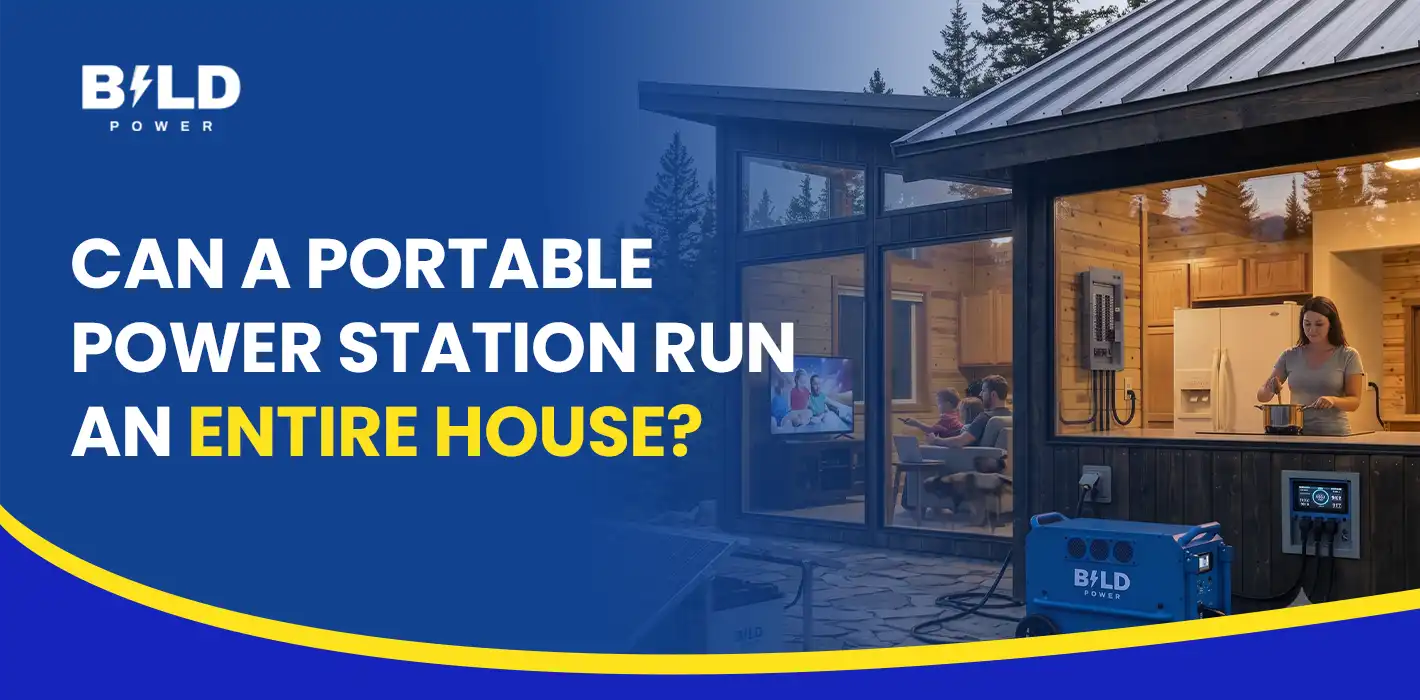
A power station can run an entire house during outages, but only if you prioritize important appliances over everything else. High-capacity units handle refrigerators, medical devices, lights, fans, and communication devices simultaneously without trouble.
Whole-home coverage including central air conditioning (if installed), electric water heaters, and dryers requires a very large station or multiple units working together.
Most people don’t need every appliance running at once during an outage; they need the important ones to keep working. A realistic whole-home backup covers your refrigerator, a few lights, fans, medical equipment, and phone charging without much trouble. That combination draws far less power than people expect, and a capable station handles it for days.
Refrigerators draw 150 to 400 watts, ceiling fans use 30 to 75 watts, and LED lights pull just 10 to 15 watts each. Phone and laptop chargers add another 50 to 100 watts combined. A household running these essentials together typically needs 400 to 700 watts continuously, which most high-capacity portable power stations handle without any strain.
Central air conditioning units pull 3,000 to 5,000 watts, electric water heaters demand around 4,000 watts, and electric dryers use up to 5,500 watts. Running these alongside core appliances pushes total demand beyond what most portable stations deliver continuously. These high-draw home appliances require either a very large station or a decision to go without them temporarily.
Yes, and this number matters more than output wattage for most families. A station with 9,792Wh running 500 watts of essential appliances lasts nearly 20 hours before needing a recharge. Solar panels extend this indefinitely during daylight hours, which changes the calculation entirely for multi-day outages. The OffGrid Pro accepts up to 3,700W of solar input, meaning a good panel setup keeps it charged through extended blackouts.
Output wattage determines which appliances your station can run at the same time, not how long they run. A station rated at 3,600W continuous comfortably runs a refrigerator, window AC unit, medical devices, and several smaller appliances simultaneously.
Surge wattage matters too because motors in refrigerators and AC units spike briefly on startup, and your station needs to handle that without tripping its protection circuit.
A licensed electrician can install a transfer switch that connects your power station directly to your home’s electrical panel. This setup lets you power hardwired appliances and outlets throughout your house without extension cords. You select which circuits receive backup power, and those circuits work normally the moment the grid goes down.
You can run appliances directly from your station’s outlets using standard cords without any electrical work. This approach works well for portable appliances but doesn’t reach hardwired systems like ceiling fans, hardwired lighting, or well pumps. Many families start this way and add a transfer switch later once they understand their needs better.
Solar panels turn a time-limited battery into a continuous power source that recharges through the day while you draw from it at night. A station with strong solar input capacity stays topped up during multi-day outages as long as weather cooperates. This combination of battery storage and solar generation gets you closer to true whole-home independence than battery capacity alone.
Refrigerators, medical devices, and communication equipment deserve first priority because their failure creates immediate health and safety risks. These appliances also draw relatively modest power compared to their importance, leaving capacity available for other needs.
Lights, fans, and phone chargers fall into the next category because they improve comfort and communication without demanding heavy power. A few LED lights and a tower fan add only 100 to 150 watts to your total load while making the outage significantly more manageable.
Central air, electric stoves, and water heaters draw enough power to drain even large batteries quickly, so these work best on brief cycles rather than continuous operation. Running your AC for a few hours during the hottest part of the day and then switching to fans overnight stretches your battery life meaningfully.
BILD Power is a trusted choice for families who want genuine home backup without the noise and fumes of gas generators. The OffGrid Pro delivers 9,792Wh of LiFePO4 capacity, 7,200W output, and 3,700W solar input compatibility, making it one of the most capable portable stations available for protecting your home through any outage.