

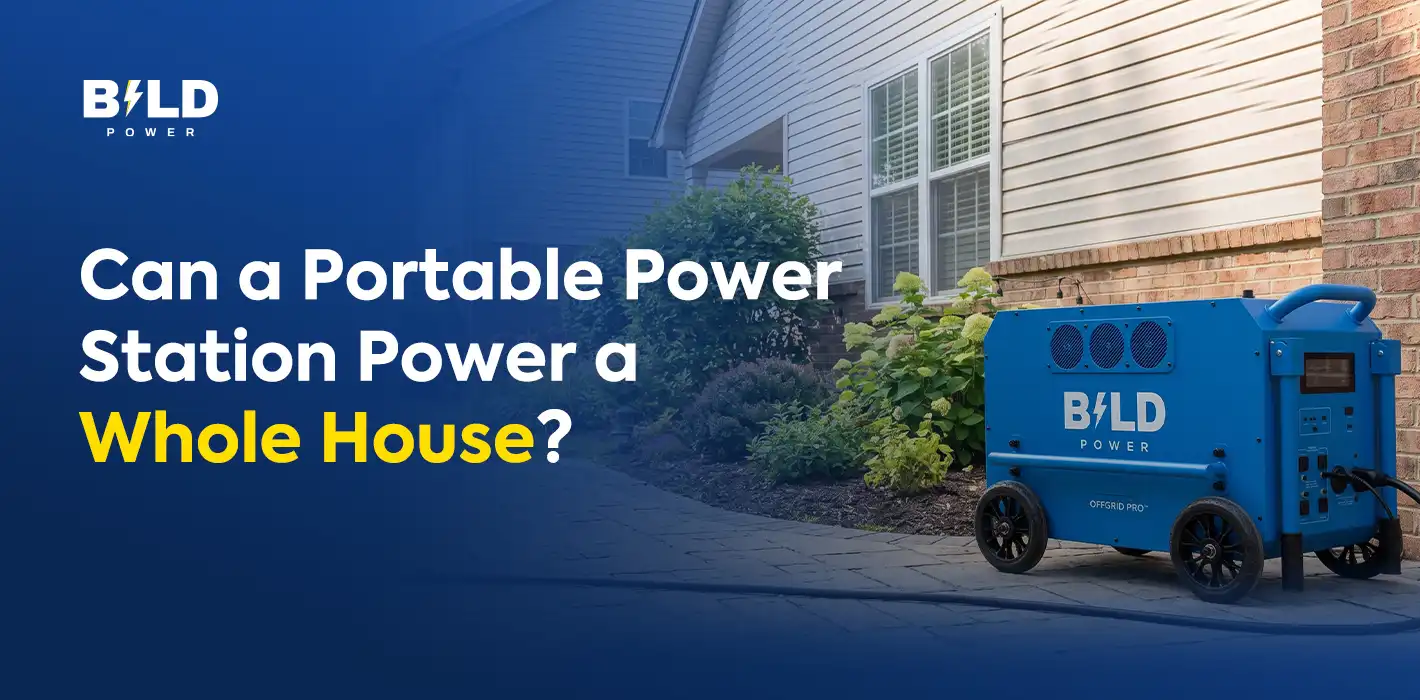
Yes, a portable power station can power a whole house during outages when a homeowner focuses more on essential appliances rather than running everything at once. High-capacity units handle refrigerators, medical devices, fans, lights, and charging needs simultaneously without much trouble.
The right station size, output rating, and solar charging setup determine how much of your home stays comfortable and functional throughout any outage.
A portable power station stores electricity in a large battery and releases it through outlets just like your wall sockets do. You plug appliances directly into the station or connect it to your home’s electrical panel through a transfer switch installed by an electrician. Either approach gives your household access to backup electricity without a gas generator running outside.
Every power station has a continuous output rating that caps how much power it delivers at one time. A station rated at 3,600W continuous can run multiple appliances simultaneously as long as their combined wattage stays below that ceiling. Adding appliances beyond that limit trips the station’s protection circuit and cuts power until you reduce the load.
Battery capacity, measured in watt-hours, determines how long your appliances run before the station needs recharging. A 9,792Wh station running 400 watts of combined essential appliances lasts roughly 24 hours on a single charge. Solar panels connected to the station recharge it during daylight, extending protection well beyond what the battery alone provides.
Your refrigerator deserves first priority because food and medication spoil quickly without consistent cooling. A typical fridge draws 150 to 400 watts continuously, which leaves plenty of remaining capacity for other appliances on a high-output station.
Fans, CPAP machines, and bedside lighting keep sleeping areas comfortable and safe through the night. These appliances draw modest power combined, typically under 200 watts total, and run easily alongside your refrigerator without straining most capable stations.
Lights, phone chargers, laptops, and a television keep your household informed and comfortable during extended outages. LED lighting throughout your home adds only 50 to 100 watts total, which leaves remaining capacity available for other needs.
Window AC units drawing 500 to 1,500 watts run well on high-capacity stations, and the OffGrid Pro with 7,200W output handles their startup surges without tripping. Central air conditioning systems demand significantly more power and work better on brief cycles rather than continuous operation.
Well pumps draw 1,000 to 2,500 watts while running, with startup surges reaching two to three times that amount briefly. A station with strong surge handling keeps your water supply working during outages, which matters enormously for households without municipal water service.
Solar panels connected to your power station recharge it continuously during daylight hours while you draw from it simultaneously. The OffGrid Pro accepts up to 3,700W of solar input, meaning a good panel setup fully restores its 9,792Wh battery within a single sunny day. This combination of large battery capacity and fast solar recharging turns a time-limited backup into a whole-home battery backup solution.
Smaller spaces need less total power because fewer appliances run simultaneously and less lighting covers the entire area. A station in the 3,000 to 5,000Wh range handles essential coverage comfortably for apartments and smaller homes during typical outages.
Larger homes with more occupants, more appliances, and greater square footage to light and cool need higher-capacity stations with more output wattage. A 9,000Wh or larger station with 7,000W or more of output gives larger households the headroom to run multiple appliances comfortably without constantly managing load limits.
BILD Power is a trusted choice for families who want reliable whole-home backup without noise, fumes, or fuel dependency. The OffGrid Pro delivers 9,792Wh of LiFePO4 capacity, 7,200W output, and 3,700W solar input compatibility, making it one of the strongest options available for powering your entire household through any outage.